
Why I Built the Identity Audit
There's a pattern I've noticed in how people talk about retirement.
Ask about the finances and most people can speak fluently: the number, the timeline, the plan, the adviser. Ask who they'll be once the career winds down, and the conversation goes quiet. Not because the question doesn't matter, but because nobody has ever asked it, and there's nowhere obvious to go to work on it.
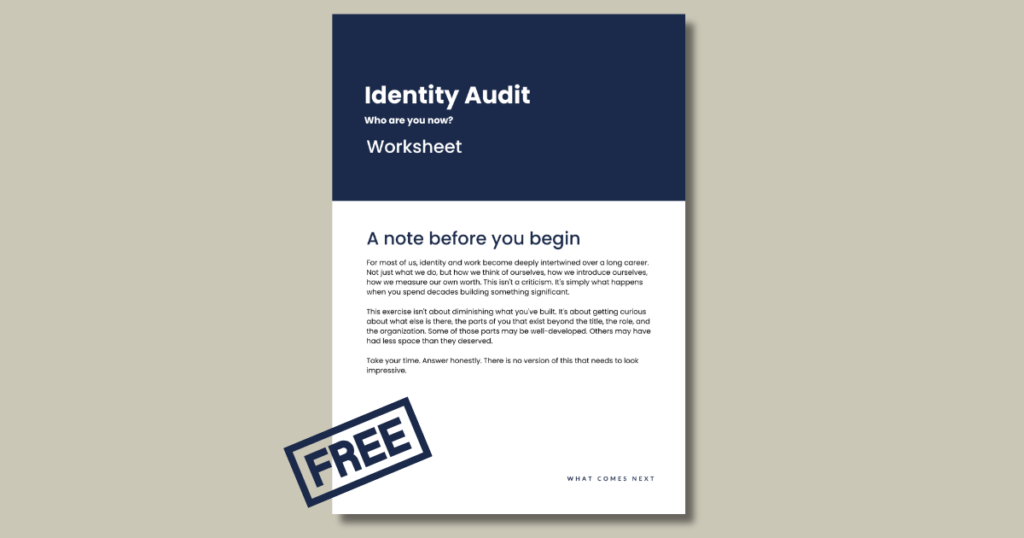
The financial side of retirement has an entire industry behind it. The identity side has almost nothing. That gap is why I built the Identity Audit: a free reflective worksheet for the question the financial plan never touches. Who are you now?
It's worth walking through what it actually asks, because the questions themselves tell you why this work matters.
How you see yourself now
The audit opens where most of us are: with the introduction. How do you currently introduce yourself at a social event? Write what you actually say, not what you think you should say.
Then the harder version: how would you introduce yourself if you couldn't mention your job title, your company, or your profession?
Most people find that second question surprisingly difficult, and the difficulty is the point. It isn't a flaw or a sign something has gone wrong. It's simply what happens when you spend decades building something significant: the title quietly becomes the self-description, and nobody notices the substitution until it's asked to step aside.
How others see you
The second section shifts the mirror. What three words do the people closest to you use to describe you? Not your professional reputation. You, as a person.
It also asks what those people would say you're like at your best, and what they'd say you're like under pressure. That last one matters more than it looks: knowing your own patterns is part of navigating any major transition well. The people around you have been watching you be yourself for years. They often hold a clearer picture of who you are beyond the role than you do.
What your career expressed, and what it constrained
This is the section people tell me stays with them.
A long career isn't only something that absorbed you. It also let you express real parts of yourself: strengths, values, ways of working that the role gave space to. The audit asks you to name those, because they don't retire when you do.
But it also asks the quieter question. What parts of yourself have had less space during your working years? Interests, qualities, ways of being that got set aside, not because they weren't real, but because there wasn't room. Sometimes the same drive that builds a career also narrows a life. Noticing that isn't a criticism of what you built. It's an inventory of what's waiting.
Who you are becoming
The final section looks forward, and it makes a distinction the whole worksheet turns on: not what you want to do in this next chapter, but who you want to be in it.
Retirement conversations jump to activities almost immediately. Travel, hobbies, the list of things to fill the days. The becoming question sits underneath all of that, and answered well, it's what makes the list mean something. What qualities do you want more of? What would it mean to feel like yourself, fully, without the scaffolding of a career?
What the audit isn't
It's not a crisis exercise, and it's not about diminishing anything you've built. It's about getting curious about what else is there: the parts of you that exist beyond the title, the role, and the organization. Some of those parts may be well-developed. Others may have had less space than they deserved.
There are no scores and no right answers. As the worksheet itself says: take your time, answer honestly; there is no version of this that needs to look impressive. The places where an answer doesn't come easily are usually the most useful places to sit a while longer.
Final thoughts
Retirement isn't just a financial transition. It's an identity transition, and identity work rewards structure. A vague intention to "figure out who I am" goes nowhere. Honest answers to specific questions, on paper, go somewhere.
The Identity Audit is free to download at theretirementseries.com. It takes most people a quiet hour, and the thinking it starts tends to run a good deal longer.
